
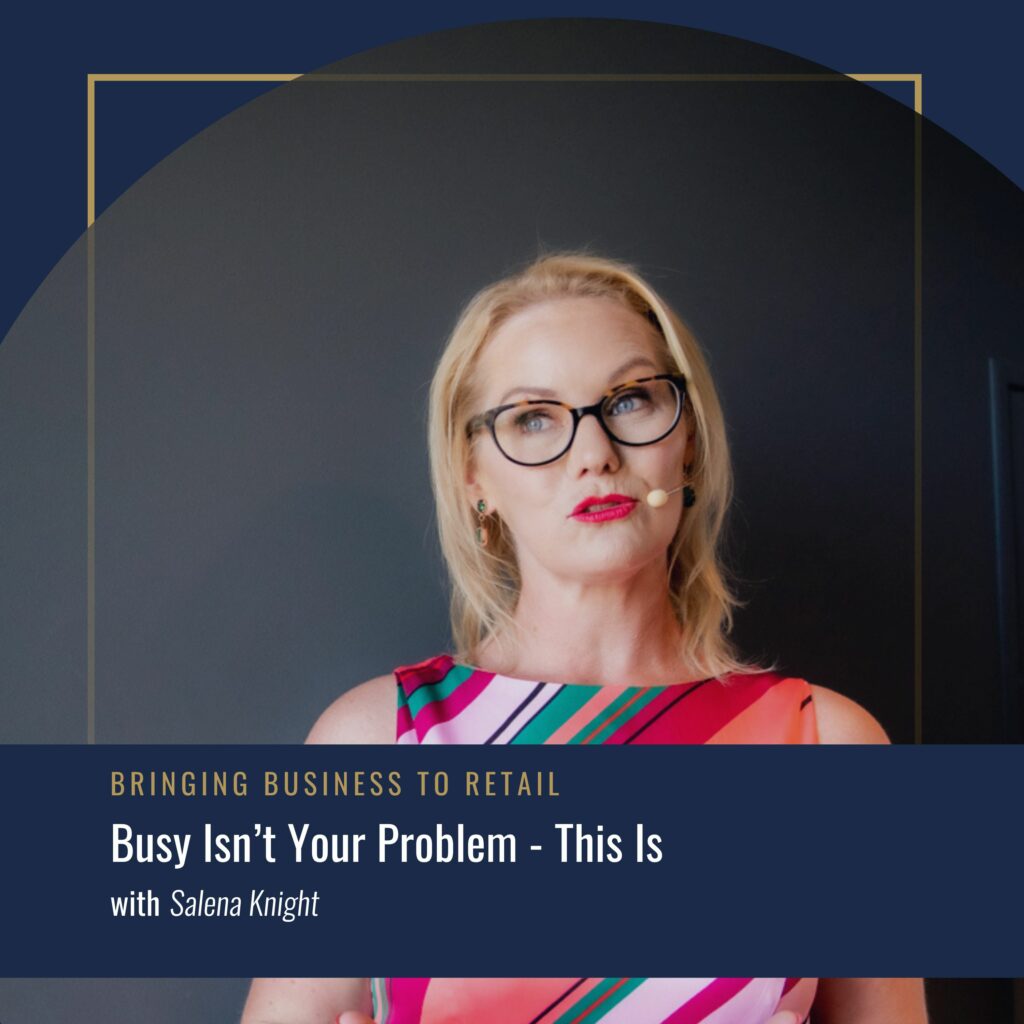


SHOW NOTES
Most retail and ecommerce business owners are exhausted, busy, and still stuck. Not because they’re bad at business, but because they’re spending their time in the wrong category of work.
In this episode, Salena breaks down the difference between BAU work and CEO work and introduces a clear, practical time allocation framework designed specifically for independent retailers and ecommerce founders.
You’ll learn:
- Why being busy does not equal progress
- The four categories of CEO work and where your time should actually go
- How most business owners are unknowingly trapping themselves in operations
- A realistic 90-day time allocation target that does not require disappearing from the business
- Three actions you can take this week to start shifting out of firefighting
If you feel like you’re doing everything but still not moving forward, this episode will give you clarity and a way out.
LISTEN NOW on The Bringing Business To Retail Podcast




Final:
Hey there. We are heading to the end of January and I don't know about you, but it feels like I just blinked and we were celebrating New Year's Eve. Is it just me? I've just gotten back from a business mastermind in California and I have to say, when you are somewhere where in the middle of winter it is 24 degrees Celsius, that is like in the 70s in America and sunny and you can sit by the pool, that is a lovely place to be. Now, as always, my brain when I finish up with one of these events is literally swimming with new ideas, things that need to be changed, things that need to be fixed, things that need to be optimized. I mean, the speakers were so insightful. From wealth creation to meta ads optimization, all about the Andromeda Update. We talked about leadership and organizational psychology right through to personal brand building. I know that's a lot, right, for three days. But what I have learned is that I really need to take a couple of days after the events to just sit by the pool, process, write everything down, and then go back and make a list of the things that will have immediate impact in the business. So in this case, things such as small tweaks to our ads to accommodate the Andromeda changes right through to the nice to have. But the reality is there is no way that we could fit them into our already full schedule for Q1 and Q2. It's hard, right? I know all of these things, I want all of these things. Knowing these things, but having to say no to them, even when you know that they would be helpful and probably would even increase your revenue. So as I thought about this week's episode, I just kept coming back to this workshop that I held in December for my 5X advisory clients. And it was all around Q1 leadership planning, and the section that got the most questions and the most insight and intrigue was around where you should spend your time as the owner and the leader of the business. I decided to pull from both of those scenarios, both the Mastermind and that workshop that I did to build this week's episode around why you're likely super busy, but you feel stuck. Welcome to the Bringing Business to Retail show, where we dive into the tools, the strategies, the leadership decisions that make your business more money. So let me start this episode with a question. Have you ever finished a full day? Emails are answered, orders are packed, customers are handled, all of those team issues are sorted, and then you've gotten home, you've flopped onto the sofa, and you thought, why does it feel like I've done nothing that actually moved the needle? Nothing that moved the business forward? Not that nothing got done. I mean, you were busy, but nothing that moved the business forward. Now, I don't know about you, but I have had those days a lot. So if that is you, I would love you to pay attention to this episode. Because what I'm going to walk you through is what I have learned. And it is the exact reason that I see so many retail and e-commerce businesses feeling stuck and overwhelmed and permanently behind even when revenue looks okay on paper. Let me be clear. It is not because you're lazy. In fact, it is the exact opposite I know that you like to do. It is not because you are bad at business. I mean, heck, you would not be listening to this podcast if you were bad at business. And it is definitely not because you are missing more strategies and more tactics. Can you call this a strategy? I'm going to call it a framework. I'm going to give you my framework. The reality is, it's because you're spending your time in the wrong category of work. So today, we're going to draw a very clear line between BAU and CEO work. Now, if you don't know what I'm talking about, that's totally okay, because I'm going to break it down. So more importantly, I'm going to show you how I feel. A CEO at your level should be allocating their time if they want growth, if they want leverage, and more importantly, if they want breathing room. Because until you understand the distinction, you will keep firefighting. The downside is you'll be calling it leadership. So before we go any further, I want to be very clear. You will always have a constraint in your business. Now, having a constraint in your business does not mean that everything else disappears. As your business grows, the constraints will change. What is a constraint for you at $200,000 a year is a very different constraint to $200,000 a month. So when I say you're going to have a constraint in your business, every business has a constraint. I don't care if you're Coca Cola, if you're Lululemon, or if you just have one store and you're trying to build it up. The reality is everybody has a constraint. So having that constraint does not mean that everything else disappears in your business. Now, this is important because I'm going to talk a lot about working on constraints. So your business still has to run. Customers need to be served, those orders still need to be packed and Fulfilled. The stock still needs to be ordered, it needs to be counted, bills still need to be paid. That is BAU business as usual. Now a fun fact here is I remember hiring somebody who had come from a big enterprise level company and I thought, this will be fantastic. They'll bring some much needed polish and shine to the business. And, I remember on the first day he said to me, okay, so what percentage of my day is BAU and what percent is something else? And I was like, yeah, yeah, yeah, yeah. Well, okay, well let's, let's just kind of come back to that. At the end of the day, I had no idea what he was talking about. I had to look up and Google BAU business as usual. If you've just learned that, don't worry, it was only a few years ago that I learned that as well. So BAU business as usual is not bad. It is the stuff. It is the doing. It is necessary. But here's the problem. Most business owners never separate running the business from leading the business. That's what we're going to talk about today. Running the business. B A U Leading the business. C E O so when you are constantly in the business, everything feels urgent. Everything, everything feels important. Every day becomes a blur of reaction and firefighting. At this point, some of you may be thinking, but Sal, I know that my constraint is cash flow. Most of you are going to say it's cash flow or it's marketing. But if my constraint is cash flow, I need to fix the email marketing to get the cash flow or my constraint is marketing. But I still need to manage inventory and my team. I hear you. And this is exactly where people get stuck. Because without this clear distinction between bau, the business as usual work and the CEO work, the leadership work, you end up trying to do everything. And none of it gets done strategically. So let's draw that line properly because the trap most business owners fall into, and here's what I see over and over again and again. And honestly, I will tell you, I see this same thing at someone who is doing $500,000 a year. As someone who is making $5 million a year, most retail and e-commerce business owners spend. Okay, I'm going to throw some math at you here, so just kind of bear with me. I know I kind of feel like I need a whiteboard right now, but most retail and e commerce business owners that I have seen spend around about 60 to 70% of their time in the doing so in the operations side of things, they spend about 20 to 30% of their time firefighting, between like 80 and 90. 80 to 90% of their time doing things or firefighting. And maybe 10% on fixing what is actually holding the business back. And even worse, almost no time for thinking long term. And then they wonder why revenue plateaus, margins don't improve. The team keeps relying on them. The team makes every decision come through them. The business feels fragile. The business feels like it is just one bad decision from falling apart. And the owner or the founder has so much weighing on them. Now, I know that for you guys it's not a motivation problem. Most of you, if I give you a task, you get it done. What it is, is a time allocation problem. And they don't teach us this stuff in school. So let me show you what I feel like CEO time should look like for most of you listening and what I think the rest of your time should look like. So I'm going to call this the CEO Time Allocation Framework. Okay, The CEO Time Allocation Framework. When you're operating as the CEO of your business and not the Chief Everything Officer, your strategic time falls into four categories. Not seven, not 15, just four. Okay, what are those? Constraint removal. Remember I said that at any level of your business there will be some kind of constraint. Then we have business as usual oversight, then we have vision and leadership, and then we have the operations, the doing. So let's break down what's in each and how much time you might allocate to each one of those buckets, how much time you're allocating now and how much time we want to look at in the next 90 days. I love working in 90 day sprints because everything is achievable. We can get to the end point and it's not so far away that we feel like we're never going to achieve it. Bucket number one, constraint removal. And this, I've started with it first because this is where growth happens. So ideally I would like to see you spending most of your time here, like 40 to 60%. Now, constraint removal means working on what is holding the business back right now. So that could be your pricing strategy, it could be cash flow fixes, it could be hiring or restructuring, it could be building systems, it could be improving margins, it could be developing the people in your team, developing leaders. So this is your game plan. If this work doesn't get done, the business doesn't move. It doesn't matter how busy you are elsewhere. And yet this is where most business owners spend the least amount of time. So that is constraint removal. It is working on the thing that is holding your business back. Next up is BAU oversight. This may get a little bit confusing. I see a lot of people get confused about the doing and the oversight. So BAU oversight, business as usual oversight is not doing the work. It is monitoring, it is leading, it is reviewing, it is managing. So what does that look like? It could be checking in on your metrics, it could be team check ins, it could be performance appraisals, it could be approving decisions, it could be risk management, it could be decision making that only you can do. Notice the difference. You're overseeing, you're not executing, you're making sure the machine runs, but you are not the machine. So ideally I would like you to see around 20 to 30% of your time in that BAU oversight. Okay, so to recap, we've got the majority of your time in CEO constraint removal. Then we've got 20 to 30% in business as usual oversight, the leading and the managing. Next, this is my favorite and this is where I spent my two days. Vision and creative leverage. This is the future building work. This is where you step out of the weeds. In my case, you sat by a pool with your notebook and you downloaded. Where is the business going? What opportunities are we missing? What, what does the next phase look like? This includes your vision. It might be partnerships, it could be high level marketing direction, it could be brand positioning. And I know for many of you, I know for me for many years that felt like a luxury. But businesses that don't make that space for the thinking, and I've been talking about this a lot over the last couple of months, like, you know, might call it white space or thinking space. If you don't make time for that space, you stay small. I can guarantee you that if you've got a business that's never cracked a million dollars, it's because you've never thought past that. It's because you're not thinking, what do we have to do to get there? So we don't want to stay small. If you're listening to this podcast, we want to grow. So even if your revenue is growing, the business can stay small internally. So I've seen seven figure businesses which are small on the inside. And I don't mean small as in a lean team. I am all for lean teams, my friend. I mean small in. They are afraid to make decisions because of fear because they don't want to move outside of their comfort bubble. If you could spend 10 to 20% of your time in vision mapping out where the business is going, then you are much more likely to get there rather than just putting your head down and turning up and doing the same thing every day. That makes sense. Right, so let's recap. We've got the majority of your time in CEO constraint removal, like 40 to 60%. Then next 20 to 30% in that business as usual oversight, the leading around 10% in vision. So what's left? It's the operational stuff, the hands on stuff. How much time do you spend here versus how much time should you spend here? Well, ideally I would love it if you spent less than 10% of your time doing and most of you are going to be like hell no. Sal, as a CEO, less than 10% of your time should be hands-on operations. If you go to Coca Cola, you're not going to see the CEO packing orders. But I know that you are not Coca Cola yet. You're an independent business and often it is all hands in packing orders, answering emails, posting on social media. But the reality is most operational tasks are ones that somebody else could be doing. And generally speaking, the reason that you haven't hired that person is because you can't afford them. Whilst spending half of your time in removing the bottleneck of your business. 30% in BAU oversight, 10 to 20% in vision and just 10% in your operations. I can see, as I say this, you might feel like I've just smacked you down and you might think that that is not possible. Let's move forward. Here's your current reality for most business owners and this is what I say. I've audited over 500 businesses. I ordered 80, audited 87 businesses last year, just myself alone, not including the ones that my team looked at that I as a third party removed. So personally I audited 87 businesses last year. Now for most of you, where you spend your time looks a little bit like this. 70 to 100% in operations, 20 to 30% in firefighting. I didn't even mention firefighting in the CEO stuff, did I? So 70 to 100% in operations, twenty to 30% in firefighting, maybe 10% in constraint removal and 0 to 2% in vision. And that is why people feel exhausted but stuck. If you are spending, if we're going to break this down, if you are spending six to eight hours of your day just doing the work in operations, there is no space left to fix the constraint. The two hours that's left, you have to fit all those other things into the BAU oversight, the vision The CEO level work, the constraint removal. And if the constraint doesn't get fixed, the business can't grow. So be honest with yourself. In a typical week, how is your strategic time actually allocated? I like to break this down into hours. I find it much easier. In fact, I actually block out my calendar. I did a whole podcast episode about that. I love being able to see on my calendar. Is this a strategic time? Is this constraint removal? Is this vision time? How much of your time is spent fixing bottlenecks? How much is oversight? How much is vision? How much is execution? Now let me be clear. I'm not judging you because you could be just starting out or you could have a multimillion dollar business. What I want you to do is to think about what reality is right now for you so that we have a starting point. There's no judgment. The starting point just gives us a realistic point to move forward from. What does a realistic 90 day target look like? Now, obviously this is going to be different depending on where you're at in your business. And you can't remove yourself overnight, I can tell you that. In fact, what we tend to find is it takes a good 12 to 24 months to be able to hit those aspirational targets that I just mentioned. So a realistic 90 day target. And I would urge you to write this down so that you can see it on paper. I don't know about you, but if I see it on paper, it's much easier for me to fathom. And so that would probably look like if you could spend 30% of your time in constraint removal, I know that your business would grow maybe 15% in that BAU oversight, the leading looking after your team, the looking at your metrics, those decision making times, 15% on BAU oversight, 5% in vision. Like if you just spent just 5% of your time, 5% of your week, of your month, of your quarter, what would that look like for your business? Knowing where you want to go and then that leaves around 50% of time in operations. You'd still be involved, but just not trapped. So as you move forward, I would urge you to think about every time you make a decision, filter it through this lens. Does this move me closer to that allocation of time or does it move me further away? You know I love a good action plan. So here are three actions that you can take this week. The first one, identify your constraint. Not one, not five, not 20 things that need to be done. But what is the one thing, the one thing if you could just break through that rock everything would be so much easier. Maybe it's cash flow, maybe it's traffic, maybe it's better margins, maybe it's better your team being more capable. If your team could just do more things, would that make your life easier? I don't know about you, but it would for me. Always does for me. So I want you to block some time out to just think about that white space. Think about what is holding you back. The second thing separates the doing from the overseeing. So ask yourself, what am I doing that could be monitored instead? So for example, do you actually need to write the emails for your email marketing or could you just approve them? Do you really need to count the stock yourself or would your time be better off spent reviewing your sell through rates? One of those is a job that can be allocated. One is a decision that has serious consequences for your business. And number three, take some time to think ahead. Take some time to look at where your business is going and what you want from it and protect that time. Literally. Book it into your calendar. Like I said, I like to block things out in my calendar. I like to color code this time. So just like I told you, I booked out those extra days to sit by the pool with my notebook after the event. It is not a luxury. I know it looks like a luxury from the outside, but the reality is it is a necessity if I want to move the business forward. Let's wrap this up. I feel like this was supposed to be quite light hearted and it's turned into something quite heavy. So let's bring it back. Bring back the energy. Business as usual is the stuff that keeps the lights on. The CEO's work builds the future. And if you don't draw the line, then you and I both know the urgent stuff will always win. The firefighting will always take precedence and that is how good businesses stay stuck. I don't want you to be stuck. I want you to grow your business to the business that you have always dreamed of. The business that works for you, not against you. So if you're listening to this and thinking, I get it, but I don't know how to make the shift, well, that is exactly what we do. Inside of the 5X strategic advisory program. I have got just one spot left in this Q1, Q1 of 2026. That is I'm still, my brain is still thinking it's 2025. But we have one spot left in Q1 to work with us. One on one inside of the 5X strategic advisory program. If you want help moving out of firefighting, moving out of operations, moving more into CEO level control. Head over to celinanight.com forward/5x and you can book a call and we'll see if you qualify. Remember, staying busy isn't the goal, but building a business that works without you having to do everything is. Thank you so much for joining me on the episode. I really hope you found it useful. Celina knight.com 5x if you want to see if the 5x program is the right fit for you, thank you so much. I'll see you in the next episode. So that's a wrap.
I'd love to hear what insight you've gotten from this episode and how you're.
Going to put it into action.
If you're a social kind of person, follow me @salenaknight and make sure to leave a comment and let me know. And if this episode made you think a little bit differently, or gave you some inspiration, or perhaps gave you the.
Kick that you needed to take action.
Then please take a couple of minutes to leave me a review on your platform of choice. Because the more reviews the show gets, the more independent retail and e-commerce stores just like yours that we can help to scale. And when that happens, it's a win for you, a win for your community, and a win for your customers.
Share this episode
Watch The Video
Ready For More?

Black Friday doesn’t have to mean giving away your profits. In this episode, Salena Knight
Facebook-f Instagram Linkedin LISTEN NOW SHOW NOTES Many store owners assume cashflow problems come from
What if your rent, utilities, and overhead were paid every single month — before you