SHOW NOTES
When you reward loyal customers, the instinct is to be generous. A free gift once they spend a certain amount, a thank you event, something that says they matter. One store owner planned a free sweater for every $150 spend at her VIP night. So does it add up?
What you’ll hear
- What happened when one of Australia’s biggest beauty retailers sent its top spenders their thank you gift, and the only maths a loyal customer does.
- Why a gift that costs you the same as your usual 20% off can still be the wrong offer.
- The cost Sal says almost every store owner leaves out when they price an event night.
- What happens when Sal runs a $10,000 target against a room of 50 to 60 regulars.
How much should you give away when you reward loyal customers?
Whatever you give, your customer holds it up against everything they’ve spent with you. What it cost you doesn’t come into it. Give too little and loyal customers feel short changed. Most store owners go the other way and give too much when they reward loyal customers, because they love these people. Sal explains where that goes wrong.
Mecca found out the first part at the start of this year. Its top customers spend $3,500 or more a year and were used to gift boxes worth up to $100. Then this year’s reward arrived.
Will your offer to reward loyal customers pay for itself?
Start with what you need the offer to bring in. Then check it against what your past events and promotions tell you: how many people come, how many of them buy and how much they spend. A spend level picked because it sounds about right can set the whole thing up wrong before the doors even open.
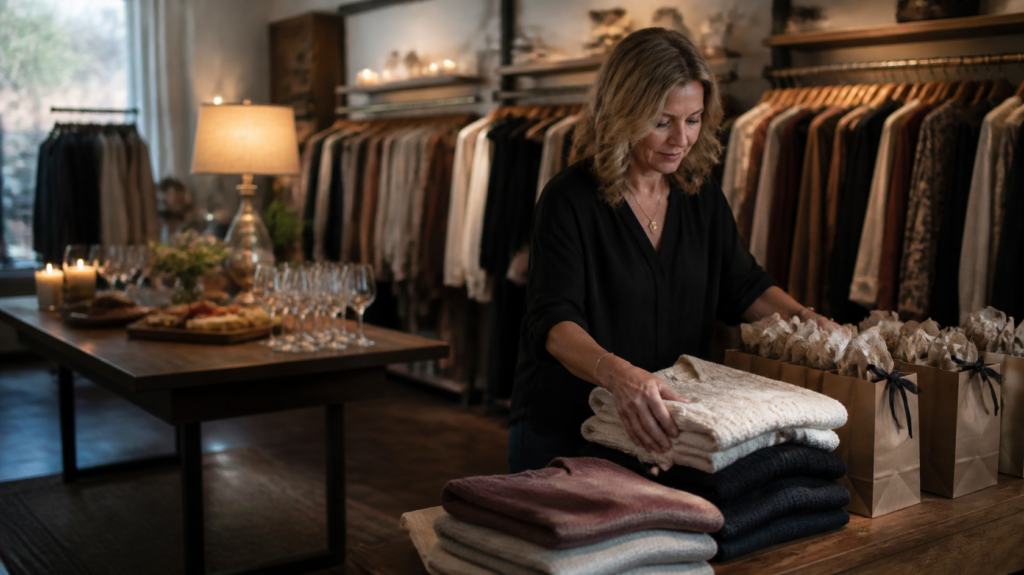
A store owner in a country town has run her VIP night for ten years. Fifty to sixty regulars come in for three hours and spend what she’d usually take in three to five days. This year she wants $10,000, no discount, and a free $80 sweater for anyone who spends $150. Sal runs her numbers live.
Key moments in this episode
- 00:48 The thank you gift that had loyal customers calling it a scam
- 02:05 The thank you mistake Sal made in her own store
- 05:55 The offer that looked like it cost the same as a discount
- 07:33 The cost that almost never makes it into the sums
- 10:31 The numbers that show a problem before anyone walks in
- 12:01 Three ways Sal would get the night to $10,000
Press play to hear what Sal finds when she runs the numbers, and how she’d set up the offer instead.
Resources mentioned
My Black Friday Formula (My BFF)
Episode 546: Should You Discount End-of-Season Stock This Black Friday?
And if Black Friday is still on your to-do list, My Black Friday Formula interviews you about your store and builds your offers, products, emails and socials for you. It’s the same formula Michelle used to bring over $120,000 into her toy store. Get started at salenaknight.com/bff.
LISTEN NOW on The Bringing Business To Retail Podcast

Salena Knight (00:00)
If you spent thousands of dollars a year with a brand and they sent you a thank you gift that was worth, I don't know, $5, how would you feel? I don't know about you, but I would feel a little bit ripped off because you do the math. Thousands of dollars from me, five dollars back from you. That's what you think I'm worth. And this is pretty.
Hey there and welcome to the Bringing Business to Retail Podcast. I'm Salena Knight, and I'm so glad that you've joined me here because here on this podcast, we talk all about different ways that you can make money for your retail e-commerce store. Now, that little scenario is pretty much what happened to Mecca at the start of this year.
Now, if you're not in Australia and you're not into the beauty scene, Mecca is one of our biggest beauty retailers. Think of it like Sephora, but a little bit fancier. And Mecca don't do discounts. You won't see a store wide sale. The way that they reward their best customers is through a series of gifts. And the more that you spend with them in a year, the better the gifts get. At the top level, we are talking about people spending $3,500 a year or more.
Those customers get gift boxes up to nine times a year. And the products in them are valued at between $50 to $60, $80, $100. That is why Mecca's loyal customers have come to expect. And then this year the reward turned up. And it was a really cheap-looking canvas tote bag.
People were not happy. The social media was filled with people complaining because it was nowhere near what they had come to expect. Some people literally called it a scam. Now, I get it. That bag probably costs Mecca next to nothing. But the customer doesn't care what it costs you. What they're doing is holding up everything that they've spent against the product that you've given them.
They're given to them as a loyalty bonus and they're deciding it's worth. That is the only maths your customer is doing. Now, at this time of year, I know that a lot of you are planning your own VIP nights and Christmas events. And when store owners plan those nights, the mistake that I see is actually the opposite of Mecca's. They very rarely give away a cheap tote bag. Most of the time, they're giving away way too much.
And I understand it because honestly, I made this mistake way too many times when I first opened my retail store. Because we love these people. Some of them may have been shopping with you since the day that you opened. You want them to walk away feeling so spoiled and so cared for. And so you pick something very, very generous. You pick a spend amount that sounds about right. So, you know, spend $100 and you'll get the free gift. And then you maybe.
Go and work out whether it's going to make you any money or not. Now, customers, of course, love it, but an event like this can end up costing you more than it makes you. And here's the thing I don't think you have to give away the farm for your best customers to feel like they're truly cared about. And I'm telling you this because this is what I have learned in my own business. Which brings me to today's episode. This was a question that came from a store owner who lives in a small town.
They have a very, very local, local customers who love what they sell and come in all the time. Some of them have been shopping there for more than a decade. now this store runs a VIP night once a year, takes about three hours, and they get about 50 or 60 people in. And she takes three to five days worth her normal trade in that one night. That is a lot.
That is a lot to give up and a lot to change because there is already an expectation from the people who've been before. So she's done the maths, she's done 20% off. And honestly, to this time round, she wanted to know whether she should do a discount at all. This year she wants to do something juicier.
Now her heart is absolutely in the right place. So let's see let's break this problem down and see if it's gonna make her any money.
Salena Knight (04:11)
women's fashion store. You've got one brick and mortar store in a country town. Very, very loyal, loyal local base. Some people have been shopping with you for the whole time you've been open, so over a decade. Average sale depends somewhere between 40 and $80. Can we just call it 60? Because you know Sal can't do air math.
I'm gonna call it 60. your best seller is a sweater that retails at $80. And most of the regulars already have four or five, some some even have 10. Look, again, a little bit of side note, this is something that we see over and over again. Is when you have these really great customers, if you have this is what we call a money fountain. If you have a thing that sells over and over again.
we sell more of it. It just means more colorways, more style, more prints, you know, more plains [CHECK], whatever that looks like to get people buying. Like that, I have to say, money fountain if you haven't already worked that out. All right. So here is the question. I run a VIP night every year. I have done for the last 10 years. It goes for about three hours. We get 50 or 60 of our regulars to come in.
And we'll take three to five days worth of normal trade in that window. It is a big night for us. Well, yeah, three to five times what you would normally do. We have done 10% off before, we've done 20% off before, and honestly, I don't think they care about the discount. So this year I want no discount, I want something juicier instead. I'm thinking spend $150 and you get the sweater for free. Here is how I picked $150 because I knew you were going to ask me for it. I picked it as the spend level and then I worked out what a 20% discount on a $150 would sale sale would cost me, which is $30. Is that right?
Okay, I'm I'm gonna take your word for it. I haven't got my calculator here. The sweater plus the food and drinks for the night comes in just under that. Ooh, I love that you have reverse-engineered that. But before I move forward, can I just say, does that include wages? So I'm going to assume the answer is no, but can we make sure that when we're breaking these things down, we're also including whatever it costs to run this event? So
The sweater and the food and the drinks comes in at just under $30, which would be the 20% discount on the $150. So it's the same money out of my pocket as the discount I've always given, but they're getting something that they actually want instead. This year I want to do $10,000 and I want them feeling like they're true VIPs. I haven't pulled last last year's figures yet. Okay, so you know I was gonna ask that question.
Is the $150 the right spend level or should I be pushing it higher? okay. So I did have a couple of questions there. First is the cost that you said to run the event with the sweater and the food and drink. You said that's about $30. I don't think that number doesn't pass my what I call common sense rule, that that includes the wages of your team and the operating costs to be open for the night. So can we go back first of all?
And get a true cost for the event. Okay, that is just that's a background, that's a preface. But here's what you told me: the VIPs are not coming for a discount. And you costing that gift against a discount that you would have otherwise given, that's a great start. But here's where it gets a little bit muddled up.
Neither of those things is the gift. So, first of all, spend $150 and you get an $80 sweater for free. That is more than 50% of the spend threshold. Like that is a lot. That is, I'm gonna I'm gonna call it that is too much. So someone is gonna get $80 for only spending $150. Now I appreciate that the sweater probably costs you.
20 based on what you just told me, somewhere between 20 and 23, $24. But that's beside the point. It is the value to the customer. So $80 on a hundred and fifty dollar spend is way too much. And the second one is that $150 is just a number that you made up. So you didn't get it from your customers. You didn't get it from the numbers that you pulled last year.
you'll it sounds and and by all means if you did get this from somewhere else, you're more than welcome to tell me. But you gave me a lot of background. But you said you hadn't pulled last year's numbers. And so I'm guessing you've just made that number up. And so what you then did was you took this made up number and said, well if I was going to give them a discount, then that would cost me $30 and it's going to cost me $30 to give away a sweater. But what I really want is my, you know, these great people to feel like I I love them and that they really matter.
The maths that you've given, you have made fit your outcome. So, first of all, you said I'm going to assume that the outcome that you want is A, $10,000, but also B for these people to feel like they matter. I don't think you have to give away the farm for them to feel like they are truly cared about. So here is what you need to do. I need you to pull last year's figures because you have
What did you say? Like a decade's worth of these numbers. If you've been pull if you've been doing this night, I want you to pull all of those numbers. And then we want to reverse engineer from the outcome. So your outcome was $10,000. This is what we do all the time. You kind of did it. So kudos, gold star to you for trying. [CHECK] But here's what we but we were using the wrong outcome when you did those numbers. So 10, let me get my calculate, $10,000.
divided by a hundred and fifty, which is what you've asked them to spend, is sixty-six sales. So that's called sixty-six point six, sixty-seven sales.
You I think you said you get 50 to 60 people who turn up for the event. So already I see an issue, which is you can't physically meet that number because if you need 67 sales and you only get 50 to 60 people in, there's not enough people to buy. Now, yes, some people may spend more, but this is why I need you to go back and look at the reverse engineering of what is the average order value.
That they spend on that night. If it's $300, well, then we drop down to what is that, 33 sales. So we're much more aligned. But if they spend $300, why have we made the offer? $150. Do you see where I'm going here? So you said that on a normal day, your average order value sits between $40 and $80. I called it $60. But you're asking for two and a half times that amount on this sale. Now, true.
Highly likely that that will happen because these people are your VIPs. So that there's a really good chance that would happen. But I need you just to qualify that. Some people are going to spend more, some people are going to spend less, but we want 67 sales before we even hit the number of before we even be we don't have enough people coming in the room, is what I'm saying. So here are your options. I think I have three of them off the top of my head.
First of all, get more people in the room. So we need to move that to, I mean, what is your conversion rate on these nights? So we have to have the average order value and the conversion rate. If we can get a hundred people in and we can get a 67% conversion rate, we get our 67 people. Okay. So that's the first thing. Get more people in the room. Two, we need a higher average sale. So we need to get that 150 up to 250, $300.
And that's not going to happen if you're giving away $80 for $150. Okay, the people who are coming, we want them to spend as much as possible. So if we want a hundred, if we want 67 sales at 150, you will need about 100 people to opt in, which means you probably need, from my experience, anything from 150 to 200 RSVPs, because I will tell you, and we just had this last week, an event, about 30 to 40 percent.
probably won't show up. And that is with a lot of reminders as well. Because it's it's I'm guessing it's a free event. so we definitely have to be factoring that in. So that is the first part. Let's get the let's get the economics right the n sorry, let's get the numbers right and then move into the economics. I would be looking at the free gifts, 150. I would do something in the like $30 price point.
$30, sorry, $30 value price point. Maybe that is some accessories that you've got left over. We want to be looking at $30 worth of value. So $150 gets them something. $200 gets them the next thing. So $200 might get them a $40. $50, I mean $50 on $200 is what, 25%. So that's quite a big, quite a big lot of value back.
And 300, I would put $300 as getting the free sweater. So that to me, the economics, makes sense. That's an $80 gift on a $300 spend. That's pretty awesome. Now, the other thing that you could do, just to make sure that you get the people in, and definitely do the economics on this first, you could do something along the lines of the first 20 people who come in get the sweater.
Because we want the people, yeah, we want people to come in and buy. Not as huge a fan of that, because people could just come get the sweater and not buy. You could put something in here that was like the first 20 people to purchase, get the sweater, or the first 20 people to purchase anything over a certain amount, get the sweater. The reason we say that is because the scarcity is what will drive people to buy. And when people start buying,
At a live event, what I can tell you from experience is at a live event, once people start buying, everybody starts buying. Like that's it's it's you know, once the the the dam has has busted, it all comes through. And you know I'm terrible with analogies. Okay. I would definitely be planning as we go into this a cross sell to go with it. I remember that you told me that you sell a lot of earrings.
So I would be looking at how can we team up the sweater with something else and then actively be pushing people to buy that. Like we want upsells and cross sales to be going into this so we can push that amount. So if we're adding a $30 or $40 or $50 pair of earrings in, that is going to push you up. So I think the other thing, just before we even get started, we always need to know the outcome.
So there were three things that you kind of said. One is that you had a lot of these sweaters. so clearing stock was one of them. You wanted to reward customer loyalty, and you wanted the revenue. So those three can be very, very different promotions. But if the answer is $10,000, if that is your primary motivator, you need to build for the spend, not necessarily for how many people come in the door or how many units that you clear. We're just looking at.
$10,000. Now, one thing you didn't tell me, and I just want to touch on this is that is that $10,000 s the how much you want them to spend in total or how much money you want to make? Because I've made all these assumptions on it's how much money you want them to spend. If it is how much money you want to make, that is a whole different set of economics. But for now, we're just taking it as
You want them to spend $10,000. So definitely coming back, looking at the outcome, and then building our promotion for that. But then I really want you to make sure that you use the debrief sheet because this is going to be able to help you for next year. I want you to write those numbers down so that next year you are starting from data instead of a guess.
Okay, I hope that helps.
Salena Knight (17:13)
Before you go, if Black Friday is still sitting on your to-do list and you're not even sure what it is that you're going to sell yet, let alone how you're going to find the time to sit down and plan it all, listen up. We know Black Friday weekend is the highest revenue weekend of the year. It's the time that brings in the most money, but it's also the one that needs the most marketing. And it lands exactly
At the time when you're already flat out.
And so Black Friday planning gets moved to tomorrow. But tomorrow looks pretty much the same.
You've got this massive sales opportunity sitting right in front of you. But if you are trying to build the marketing for it in whatever gaps you can find, then is that really going to bring in the sales that you need? That's why I created my Black Friday formula or my BFF. It interviews you about your store and then builds you a custom
Black Friday campaign designed to get your customers buying more than once. It will work out the offers, the products, the emails, and all of the socials, all built for your store. It is the same formula that Michelle used to bring over $120,000 into her toy store. So if you want to take the biggest campaign that you will create all year off of your plate, head over to SalenaKnight.com forward slash BFF and get started.
That's Salena Knight dot com forward slash BFF.
Share this episode
Ready For More?
Q4 doesn't give you more hours in the day, but your marketing still needs to
Playing it safe can feel like good business, but it often comes at a hidden
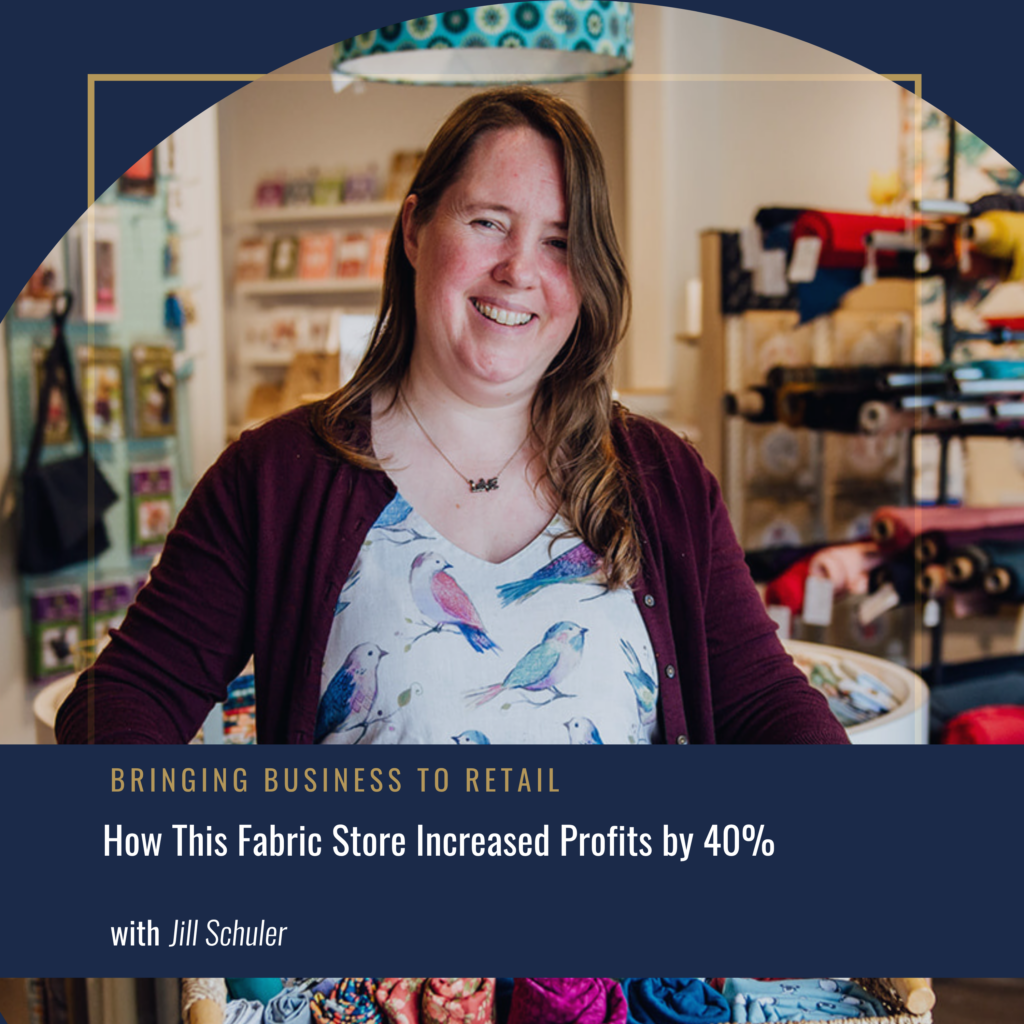
Jill, CEO of The Stitchery Studio, shares how she built a community-driven retail business and